
A parent forum thread starts like this: “My daughter is finishing third grade and reading better than ever. From here on, which tool actually helps?” Below it, twenty three comments. Each parent describes a different app, program, or method. Some loved them, some did not. Looking at the list, the question gets bigger, not smaller.
This post is here to take some of that confusion off your shoulders. Instead of marketing promises, we walk through the categories of tools that help a child with dyslexia along the reading journey. What each category does, when it fits at home, what to expect.
A quick note up front: no tool replaces a dyslexia diagnosis, and no app does the work of a specialist. But the right tool at the right moment gives a child the feeling, “I can read this.” Few things are more valuable than that confidence.
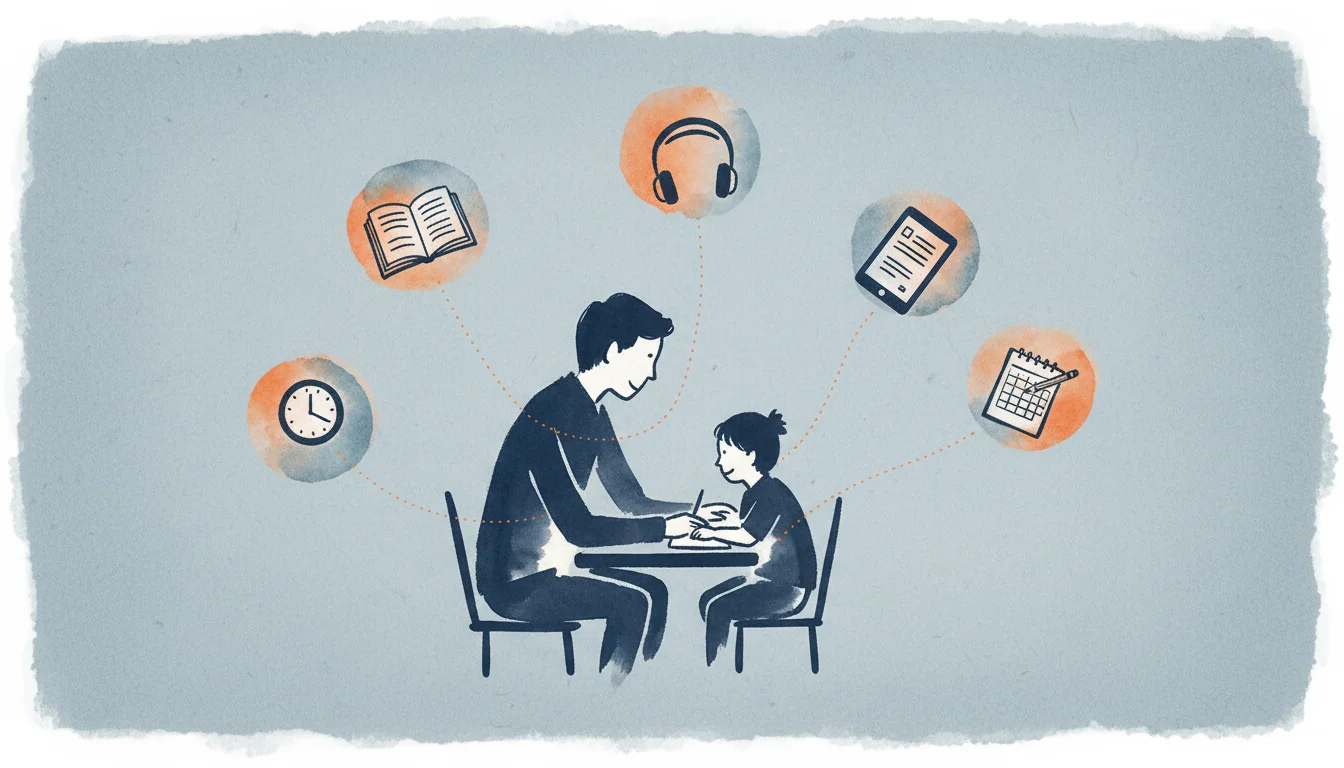
A Principle First, No Tool Helps Every Child
Dyslexia is a spectrum. A tool that transforms one child’s reading might do nothing for another. That is why your neighbor’s “this app is amazing” can land as a disappointment in your home. The reverse is also true.
The most useful rule we know is the two week trial. Try a tool for 14 days in short sessions (10 to 15 minutes a day). Then ask yourself three questions:
- Does the child come back to it on their own, or do you have to push?
- After a session, does the child feel tired or refreshed?
- After a week, do you notice a small change in any one part of reading?
If you cannot answer “yes” to all three, the tool is not the right fit for your child. Move on. Time spent on a tiring tool eats away at confidence faster than it builds skill.
Category 1, Reading Comfort Tools
This category does one job, make reading mechanically easier. Font, line height, letter spacing, background color, line tracking, all the small adjustments that bring a page closer to your child’s eye.
When does it help? When a child avoids reading, when a page looks “dense,” when their eyes keep losing the line. Comfort tools do not teach reading. They make the reading experience less tiring, so the resistance to even start fades.
Kindlexy’s Reading Tool was built exactly for this:
- Paste a school passage your child has to read tomorrow.
- Bump the font size.
- Switch to a warm cream background.
- Turn on line tracking.
The same passage that felt overwhelming now feels reachable. The new Bionic Mode option bolds the first letters of each word so the eye finds the next word a little faster.
It is free, no signup, and your child’s text never leaves the browser.
Category 2, Structured Literacy Programs
This category goes deeper. It teaches reading, not just smooths it. For dyslexic readers, structured literacy is the most reliably backed approach in the research literature.
Structured literacy teaches sound to letter relationships, syllable structure, and word roots in a deliberate sequence. The two best known schools are Orton-Gillingham and Wilson Reading System. In many countries finding a certified provider can be hard. The practical path is to work with a special education professional who uses these approaches, or to find a school reading specialist who works phonemically.
When does it help? When the child has a formal diagnosis and reading fluency lags clearly behind peers. Structured literacy does what an average app cannot, it feeds the brain process underneath reading directly.
For more, see our post on what structured literacy means for parents.
Expectation frame. These programs work in months, not weeks. The first weeks may feel flat to both child and parent. Three months in, small but real differences start to show.

Category 3, Audiobooks and Listening
The thought “audiobooks do not count as real reading” is common, but misleading. A child who listens to a story builds vocabulary, comprehension, and a sense of story shape, all foundations of reading.
When does it help? When your child wants to engage with the books their peers read, but their reading fluency is not there yet. Audiobooks bridge that gap. The child talks about the same story with friends, shares opinions, builds imagination. The confidence this generates layers on top of reading practice.
Services like Audible, Spotify Audiobooks, and Storytel offer growing children’s libraries. Many public library systems also lend audiobooks for free, including platforms like Libby.
A useful trick, place the audiobook next to the printed book, not in its place. The ideal arrangement is the child listening while watching the same words on the page or screen. This “parallel reading” naturally strengthens the bond between sound and written word. If you do not have the book in audio, Kindlexy’s Text-to-Speech tool reads any text you paste aloud and highlights each word as it is spoken, so your child can follow along on the exact same words. It is free and runs entirely in the browser.
Category 4, Writing Aids
A significant share of children with dyslexia also struggle with writing. Spelling, line layout, consistent letter shapes, the visual neatness of a homework page, all of it costs energy. Writing aids reduce that load.
Speech to text. The dictation feature on a phone or computer. The child speaks, the screen writes. It is right there in iOS keyboards (microphone icon), in Google Keyboard on Android, on Windows and Mac. Is letting the child dictate “cheating”? No. The thought is the child’s; the tool is just transport. For homework, journals, or letters, it lifts a heavy burden off the shoulders.
Text to speech. The reverse, the child hears their own paragraph read back. “Does what I wrote sound right?” gets answered by the child’s own ears. They start catching missing words and odd spellings on their own. Kindlexy’s Text-to-Speech tool does this in the browser: paste the paragraph, pick a voice, and it reads it back while highlighting each word. Free, no signup, and the text never leaves the device.
Tools that produce custom worksheets. For making short practice sheets out of the words your child is struggling with, Kindlexy’s Worksheet Generator makes the job easy. Paste a text, and it produces a printable sheet split by word or syllable. Enough for a ten minute session at the kitchen table.

Category 5, Task and Reminder Apps
A meaningful portion of children with dyslexia also have executive function difficulties. Planning, starting, sustaining, finishing, the chain weakens. When your child says “I forgot the homework,” that forgetting is usually not carelessness, it is another feature of the brain.
When does it help? As children grow (especially in middle school), homework and responsibilities multiply. Even a simple task list app can be a real relief. The key is that the child has to enjoy using it. A simple visual calendar often beats a feature heavy app for actual use.
One suggestion, a visual schedule. A whiteboard or phone app that shows the daily routine in icons. Homework, dinner, play, book, bed in sequence. The child can answer “what is next?” without asking, which is its own gift.
A Trap to Avoid, Tool Stacking
Trying all of these at once backfires. A child opening and closing four apps a day builds a habit with none of them.
One category, one tool, at least two weeks. First the comfort tool (Reading Tool), once that settles, structured support, audiobooks running in parallel. Writing aids enter as homework needs them. Not all at once, each in its place.
Where to Go Next
Helping your child with dyslexia does not require an expensive bundle. Structured literacy needs a real specialist, yes, but most of the daily reading support tools are free or low cost. What matters is patient experimentation, watching your child’s face, walking away from what tires them and investing in what energizes them.
For more, the Kindlexy blog addresses the questions parents of children with dyslexia ask most, in calm, plain language. Beyond reading support, posts on confidence, sibling dynamics, and school communication continue to grow.