
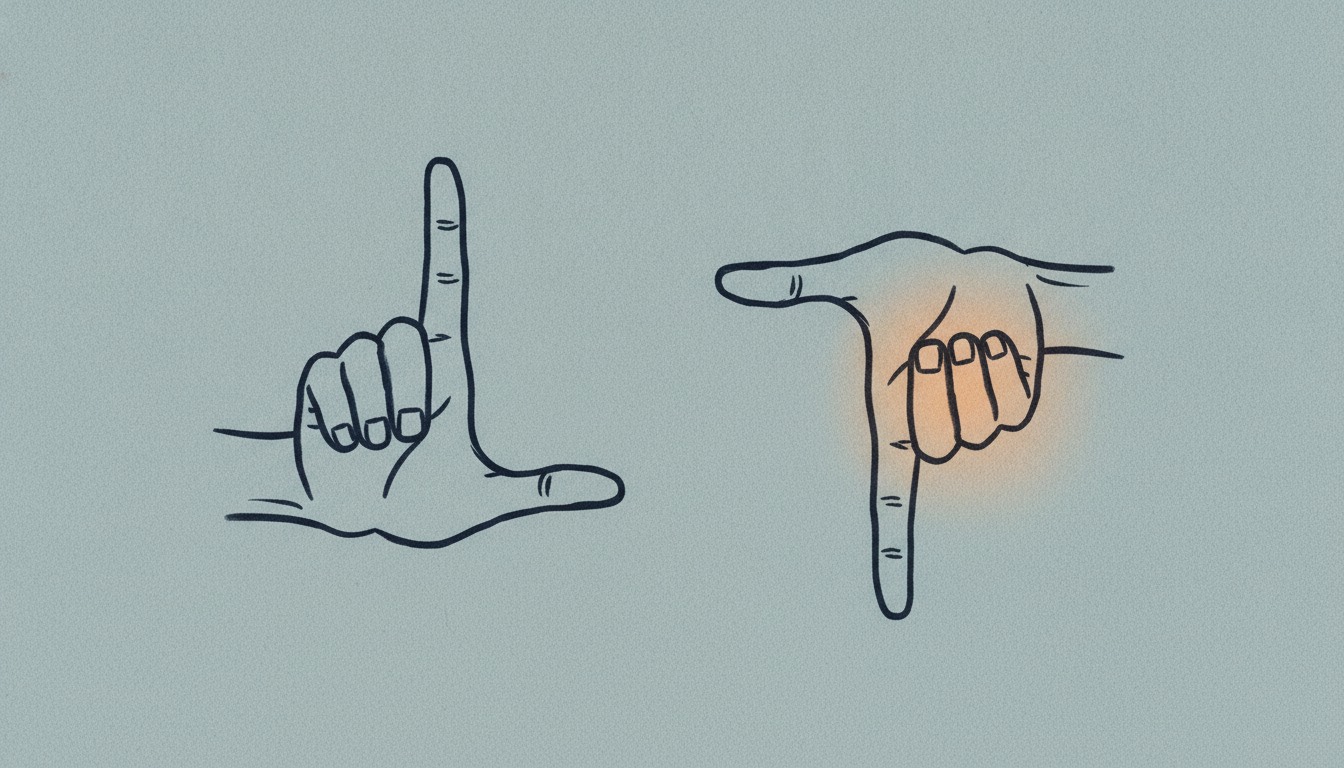
You ask your child to turn left, and they turn right. You say “it is in your other hand,” and they look at both hands, genuinely unsure. They might pause before answering, or quietly copy the child next to them. If reading and following directions already feel like a struggle, watching your child freeze over left and right can add one more worry to the pile.
Here is the first thing to know: mixing up left and right is extremely common, far more common than most people admit. Plenty of capable adults still hold up their hands under the table to check before giving directions. The question is not whether your child confuses left and right at all, it is whether the confusion is bigger, lasts longer, and travels with other signs. Understanding the difference takes the panic out of it.
Why Left and Right Are Genuinely Hard
Most of the things we teach young children have a fixed answer. Up is up. A dog is a dog. But left and right are not fixed at all. They depend entirely on which way you are facing.
Your left changes the moment you turn around. When you sit across from your child and lift “this hand,” it is on the opposite side from theirs. A left turn in the car becomes a right turn on the way home. There is nothing about the world itself that makes one side left and the other right. The labels are pure convention, attached to a body that keeps moving. That is a genuinely abstract idea, and young brains meet it long before they are really ready for it.
So when a child hesitates over left and right, they are not failing at something simple. They are wrestling with one of the more slippery concepts in early childhood, one that has no anchor in the physical world to hold onto.
The Deeper Link: Direction, Sequence, and Reading
For most children, left and right slowly sort themselves out with age. For a child with dyslexia, this kind of directional confusion can linger, and it often sits alongside other patterns that share the same roots.
Reading itself is deeply directional. We move left to right across a line, top to bottom down a page, and we hold the order of letters and sounds in mind as we go. The same skills that help a child reliably tell left from right, keeping track of direction and sequence while juggling it all in working memory, are the skills that reading leans on too. This is why directional confusion, letter reversals, and trouble with sequences like days of the week or the months often show up in the same child. They are not separate faults. They are different views of the same underlying way of processing.
This overlap is exactly why left-right confusion shows up so often in conversations about the early signs of dyslexia. On its own it proves nothing. As part of a wider pattern, it is one more piece worth noticing.
When It Is Normal, and When to Look Closer
Confusing left and right is a normal part of development, and for many people it never fully goes away without quietly being fine. It is more worth a closer look when it:
- Stays strong and frequent well past the age when most children have a steady sense of direction, usually somewhere in the early school years.
- Comes together with other difficulties, like slow or effortful reading, trouble sounding out words, mixing up the order of letters, or struggling to remember sequences.
- Causes real friction in daily life, not just an occasional slip, and seems to cost your child noticeable effort every time.
If that combination feels familiar, it is worth reading more widely rather than focusing on this one sign. Left-right confusion is closely related to letter orientation, which is why our piece on why b, d, p and q get mixed up often rings true for the same families. One sign is never a diagnosis. A lasting pattern, seen calmly and over time, is simply a reason to pay closer attention.
It Is Not Carelessness, and It Is Not About Being Slow
It helps to put two worries to rest at once.
A child who mixes up left and right is not being careless or lazy. More often they are working hard, running a quick mental check every single time, while other children answer without thinking. And it has nothing to do with how clever they are. Plenty of bright, quick-thinking children and adults still pause over left and right, because, as we have seen, it is an abstract and shifting idea, not a measure of intelligence.
Hearing “you should know this by now” lands heavily on a child who is already trying. Knowing that direction is genuinely hard lets you trade that pressure for patience and a useful trick instead.
What Actually Helps
The aim is not to drill direction until it sticks. It is to give your child a reliable anchor and gentle, repeated practice that takes the panic out of the moment.
- Give them a body anchor. The classic one is the hands: held palm out, the left hand makes a clear L shape with the thumb and first finger, the right hand does not. A small, private cue your child can check any time beats trying to remember an abstract label.
- Tie it to something they already know. Anchor “left” to the hand they do not write with, or to a familiar object that always sits on one side, like the door or the window of their room. Concrete reference points are easier to hold than the words alone.
- Make it physical and multisensory. Practice through movement, turning, dancing, pointing, “touch your left knee with your right hand”, so the idea lives in the body, not just in words. Movement helps direction stick far better than quizzing does.
- Support reading directionality too. Because reading and direction share the same wiring, short and playful practice with the left-to-right flow of sounds and words helps both. Our free sound games are built for exactly this kind of calm, no-signup practice at home.
- Keep it light and low-stakes. A relaxed cue in the moment beats a tense lesson. The goal is for the right answer to become automatic, and automatic comes from gentle repetition, never from being put on the spot.
How to Respond in the Moment
When your child turns the wrong way or freezes, a calm “check your L hands” keeps them confident enough to try. Letting them find the answer themselves, instead of sighing and pointing, is what builds the habit.
Try to keep the moment free of shame. Your child usually knows that left and right trip them up, and an impatient reaction lands harder than you might expect. What helps most is the steady message that this is a normal, solvable wobble, common even among grown-ups, and not a sign that anything is wrong with them.
Left and right are hard for a real reason. They are a moving, invisible idea with no anchor in the world, learned through patience and a good trick rather than through pressure. With a simple cue, a bit of movement, and a calm voice beside them, the confusion eases. For more gentle, practical guidance, kindlexy.com is always here.