
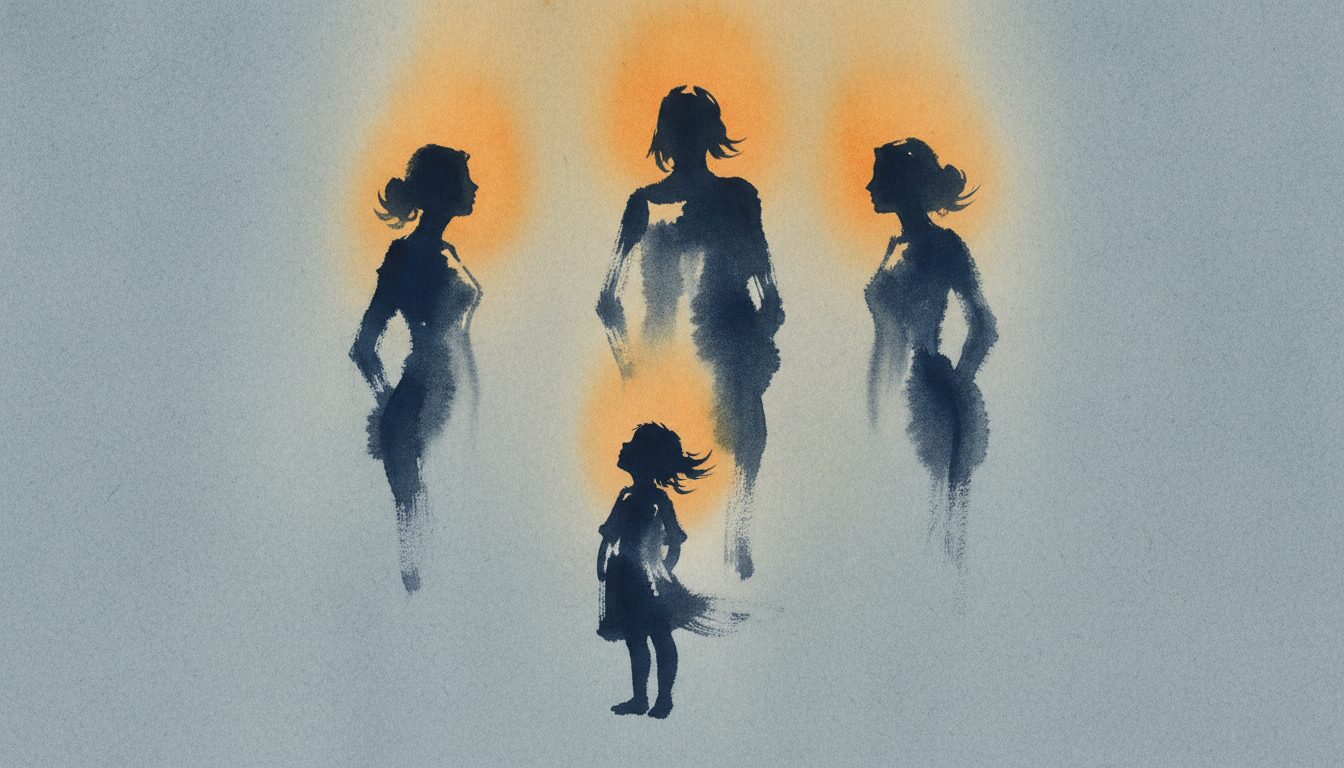
Your child is struggling with reading. One day, after a comment from a teacher or a comparison with a classmate, a question lands in the room: “Am I stupid?”
That sentence stops a parent’s heart. To answer it well, you reach into one pocket for logic and the other for love, and in that moment neither is quite enough. Then something comes to mind: tell them about people with dyslexia who built remarkable lives. Steven Spielberg, Richard Branson, Whoopi Goldberg. The names roll out and your child’s eyes might brighten a little, or might stay blank.
This article is not a list of famous people with dyslexia. It is about what these stories actually do, which patterns open a door for your child, which framing creates pressure, and the quiet traps inside the list. By the end there is a concrete framework for telling these stories at each age.
These Stories Do Three Different Jobs
A story about a person with dyslexia who built a life opens three doors at once in your child’s mind. If you tell it without knowing which one you are opening, the story falls flat. Knowing the three jobs lets you emphasize the one your child needs that day.
Mirroring. Your child sees that there is another brain like theirs out in the world. Do not underestimate this. A child with dyslexia whose parents and siblings do not have dyslexia can feel invisible and singular. “You are not alone” is an abstract comfort. “Steven Spielberg used to lose his place on a page just like you do” is a mirror. A single concrete name softens the quiet pressure of the rest of the classroom.
A field of possibility. Your child imagines a future. One of the quieter fears of a child with dyslexia is what becomes of them later. A child who struggles with reading today silently asks “what about when I grow up?” Stories of dyslexic adults give that question a shape. The answer is not “you can achieve anything.” The answer is “you still exist when you grow up. You do not disappear.” That difference is small on paper and large in a child’s inner world.
Strategy. Your child sees how adults manage. This is the most practical door. The same themes keep coming up in the stories: “I did not take notes, someone else wrote them down.” “I did not read the scripts, I listened to them.” “A teacher opened a different path for me.” The child slowly builds a private list of how-to-help-yourself ideas. Over years, that list becomes a self-advocacy habit.
Holding all three doors at once lets you choose the right tone. If your child is sad, lean into mirroring. If they are anxious, lean into possibility. If they are struggling with a task, lean into strategy.
Four Patterns That Repeat
Rather than memorizing names one by one, the more useful move is to notice the four patterns that keep returning across the stories. These patterns are the real lesson your child can take away.
Late Diagnosis, Silent Years, Then a Name
Steven Spielberg was not diagnosed with dyslexia until he was 60. He lived more than half his life with a difference he could not name. When he learned, he said something that has been quoted ever since: “It all made sense in one moment.” Cher, Salma Hayek, Tom Cruise, all of them named their dyslexia in adulthood or very late in childhood. Until then, they had carried words like “lazy,” “careless,” or “not enough.”
This pattern tells you two things. First, naming it is a powerful tool. The child gets a sentence to keep: “I am not stupid, my brain just works differently.” That sentence filters the judgments from outside. Second, for your child these silent years can be much shorter. Today, what dyslexia is, how it is identified, and how it is supported is far clearer than a generation ago. Early diagnosis lets a child move from “I am stupid” to “I am different” before the first sentence even sets in. For a deeper framework on this conversation, see our piece on how to talk with your child about dyslexia.
School Is Not the Only Way
Richard Branson did not finish secondary school. Whoopi Goldberg grew up on audiobooks and did not love printed pages as a child. Anderson Cooper had speech therapy as a child and credits learning to speak quickly with shielding him later from the fatigue of long reading.
These stories always carry an alternative path. The classic school route is not the only step in the story. When written text wears a child out, life does not close. Listening to audiobooks, learning by conversation, watching a video that shows how a thing works, all of these are legitimate paths.
For your child, this message is precious, because school says the opposite every day. Tests are written, homework is written, success is measured mostly in written text. The lesson from these stories is this: written text sits at the center not because it is the only way, but because it is the only way that gets measured. Over the years, your child can find other doors, and may even be expected to. This message does not reduce today’s difficulty, but it widens the imagined future.
One Adult, At the Right Moment
When John Irving was in high school, a teacher said “tell me the story you want to write out loud, and I will type it.” Irving eventually learned to write on his own and went on to become a globally read novelist. Octavia Spencer found a direction in life after a theater teacher gave her a part. In nearly every dyslexic adult’s story, at a turning point, there is an adult. A teacher, a relative, a mentor.
What this adult did was rarely big. It was usually a small sentence that said “there is another way.” “You are struggling with written exams, let’s do an oral one.” “Don’t write your essay, tell it to me and I’ll write it down.” “Don’t be afraid to fail, we’ll try again.” These sentences are not in any record book. The child carries them for years.
For your child, that adult is very often you. Your work is not big theoretical interventions, but small sentences in the small moments you are next to them. An evening when your child is stuck on homework and you say “if you can’t write it, tell it to me out loud and we’ll write it together later,” that becomes a story in your child’s mind a decade later. Our piece on supporting your dyslexic child at home collects the everyday practices that build these moments.
A Strengths-Based Identity
When Daniel Radcliffe spoke about his mild dyspraxia, he used a quiet tone: “It exists, it is not a problem, it is just a feature.” Octavia Spencer describes her dyslexia as “part of how I think.” Steven Spielberg credits his dyslexia with his strong visual memory.
This strengths-based language is a habit worth building. But it carries a trap. If your child is struggling to read right now, the sentence “dyslexia is a gift” can sound fake. It is not a gift they feel, it is a difficulty they live. Your job when you use strengths language is not to erase the difficulty.
A practical formula:
“I know this is hard for you. Another side of the same brain does some things really well, and I see that too.”
Two sentences. One acknowledges the pain, the other names the strength. Two truths can live in a child’s head, neither erases the other. Our piece on the hidden strengths of dyslexia builds out this two-sided framing in more detail.
The Traps in These Stories
The list of famous people with dyslexia is a well-meaning resource, but it carries a few traps. Knowing them ahead makes your conversation steadier.
“They made it, so will you” trap. This sentence sounds like motivation, but it lays a new pressure on the child. They might wonder “do I have to be famous?” The point of the list is not “every dyslexic child becomes famous.” It is “a dyslexic person grows up, stays themselves, and finds their own way.” Lean on the word “stays,” not “becomes.”
“They all succeeded, so anyone who doesn’t is doing something wrong” trap. Famous stories are stories of success. Nobody writes about the dyslexic people who did not. Your child may grow up successful, may live an ordinary life, or may build their own definition of happy. All three are legitimate. Present the stories as “one possible path,” not “the success template.”
“Dyslexia is a superpower” trap. This phrase works in some contexts, but if your child is struggling right now, it can sound too bright. In your child’s reality there is real pain. If the superpower phrase erases that pain, the child thinks their feeling has no place. “This brain is hard at some things and good at others” is a more balanced sentence. Not a superpower, but a real thing with two sides.
“Now that I told you, you should not be sad anymore” trap. Some parents tell these stories and then expect the mood to lift. When it does not, they slip into “but look at Spielberg, why are you still sad?” These stories are not there to erase today’s pain. They are there to extend the chain of hope into tomorrow. The pain stays, another sentence is added next to it. Both travel together.
How To Tell These Stories By Age
The language changes with age. Treat the framework below not as one teaching session but as a conversation that opens over years.
Ages 4 to 6: one name, a small scene. At this age, memorizing names has limited value. Instead, paint a small concrete scene. “There was a man who had a hard time reading books as a child. He grew up and made some of the best films in the world. His name was Steven.” That is enough. The child takes away “adults can have struggled as children.”
Ages 7 to 10: a few names, the common thread. At this age, children can spot patterns. Put 2 or 3 names next to each other and highlight what links them. “Spielberg’s brain reads letters a bit differently, like yours. So does Branson’s. So does Whoopi Goldberg’s. They did very different jobs, but their brains worked in similar ways.” You can ask “which one feels most like you?” Listen to the answer without judging. If they say “none of them,” accept “okay, you are you.”
Ages 11 and up: a person, not a list. A teenager can analyze stories. “Which one of these felt interesting to you?” works. Listen without interrupting. The child might reject the stories: “These are rich people, my life is nothing like theirs.” That answer is valid. Then ask “you are completely right. Who would be a more meaningful example for you?” The name the child chooses might come from a book, a music scene, or social media. All of them count.
Three things not to do.
- Do not say “they did it, you will too.” It lands as expectation.
- Do not use the stories as a measuring stick. “If you tried harder you’d be Spielberg too” is both untrue and harmful.
- Do not tell the story and ask “do you feel better now?” The child’s emotional process is not synced to your storytelling.
Three things you can do.
- Say “I am telling you this story because someone with a brain like yours grows up and is still here.”
- Emphasize the part of the story that matches your child’s need. Mirroring if sad, possibility if anxious, strategy if struggling with a task.
- Add “you do not have to walk their path, you will walk your own.” That sentence gives both distance and permission.
A Family Name Counts More
Famous people are useful because the child knows them from screens and books. But the strongest stories usually come from inside the child’s own life. If someone in your family lives with dyslexia, that person’s story is always more valuable than a celebrity’s. A parent, an uncle, a grandparent. If your child’s classroom teacher openly lives with dyslexia, hearing it from them is a powerful turning point.
Reading what dyslexia is together with your child, and adding a family story, builds a deeper bridge than any list of celebrities. “Did you know grandma also struggled with reading when she was a child?” becomes a rope that lands somewhere real in history.
The List Is Not the Bridge
Do not use this article as a list to recite. Lists get memorized but do not open doors. What your child needs is not name recall, it is the pattern behind the names. You do not have to sit your child down and read this piece from top to bottom. Instead, when your child has a hard moment, pull one suitable story from memory and tell it briefly. Another evening, a different name. Over the years a small collection grows in your child’s mind, theirs, built with you.
How to handle harder days is covered in our piece on tired days and burnout. If your teenager is wrestling with internal voice and self-talk, negative self-talk and dyslexia gives a separate framework. Each piece is a different door, distinct from the celebrity stories.
Closing
Your child does not have to become Spielberg or Branson. They do not have to be the top of the class either. Building a life that fits them, in their own definition of okay, is enough. The work the dyslexic celebrity stories actually do is not to give your child a template for success. The work is to replace the quiet sentence “I am invisible” with “I exist, others like me exist, and others like me will exist in the future.”
That replacement does not happen overnight. No child hears the name Spielberg in the evening and is whole by morning. Instead, it happens through one small story, then another, then another, and at the same time through the daily support you give at home. All of these together open a space in the child’s inner world. In that space, trust starts to settle.
As a parent, your job is not to tell a Spielberg story every day. Your job is, on your child’s hardest day, to sit next to them and say “I know it is hard, and you are not on your own. Others have walked this path too.” When the moment calls for it, you can feed that sentence with a name. When it does not, simply sitting next to them in silence is enough.
The parent-handbook series closes here. These twelve pieces were built as a reference you can return to at specific moments in your child’s dyslexia journey. From early signs to the celebrity stories, the most lasting support along this path is not the articles, but the moments you spent next to your child. Still, the articles will be there when you need them. kindlexy.com stays open for the next question.