
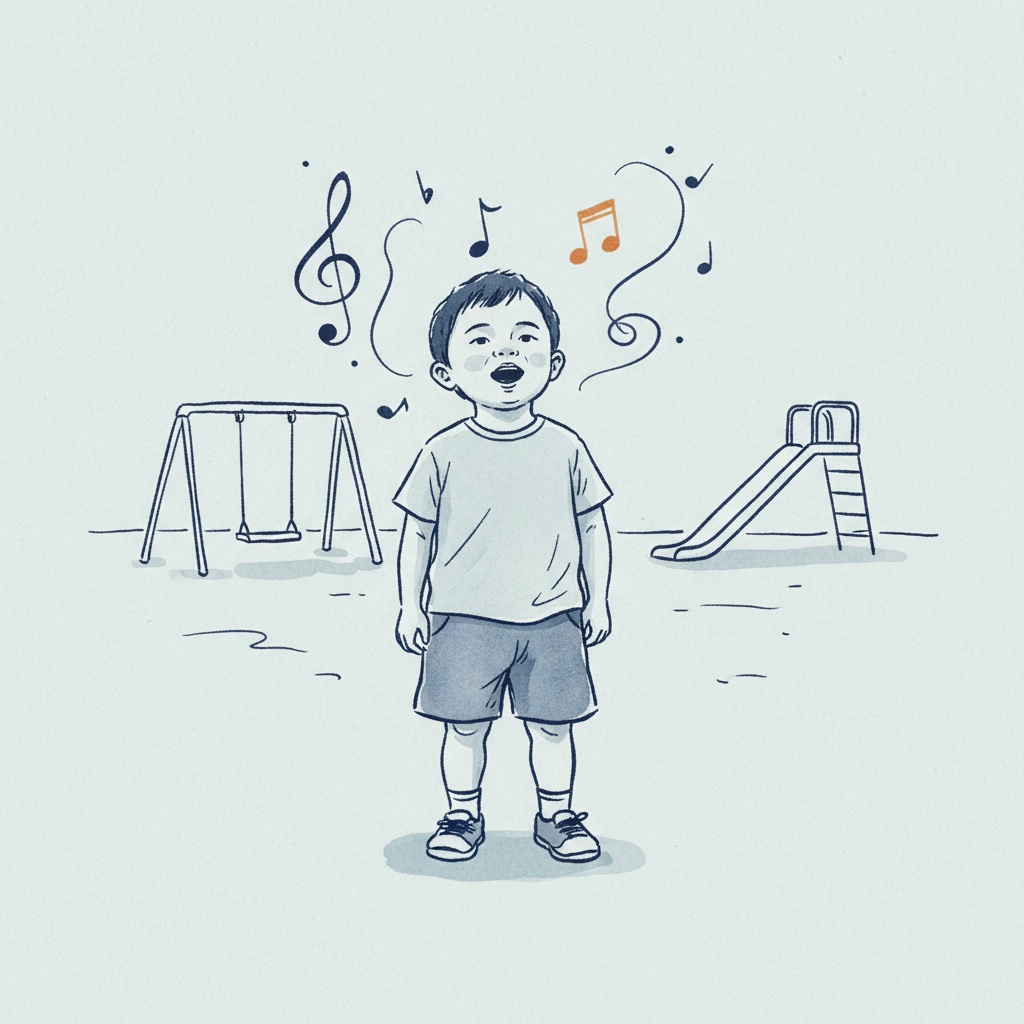
You are at the playground. A child nearby sings a simple rhyme, and when it is your child’s turn, the rhyme just will not land. You tell yourself it is nothing, that every child grows at their own pace. Still, that small moment stays with you for weeks. This post looks at what early signs of dyslexia can look like in the preschool years, which patterns are part of typical variation, and which are a good reason to talk with a specialist.
Why Looking Early Makes Sense
Watching your child closely is not the same as labeling them. Noticing early patterns is not about framing your child as “a case”. It is a form of attentive parenting that tries to understand their developmental needs. Research suggests that children who are identified and supported early have a smoother path into reading. When support is delayed, a quiet story the child tells themselves, “I cannot do this”, starts to harden, and later help has to undo that story before it can teach anything new.
This kind of attention should come from care, not from fear. The goal is not to fix or speed up your child. It is to build the right environment around their development. Over time, that attitude tends to lower the parent’s own stress as well, because the question “am I missing something” is replaced by the calm of “I am watching, and I will act if I need to”.
An early screen is not the same as a diagnosis. They are genuinely different things. A screen asks whether something in a child’s pattern is worth watching with extra care. A diagnosis comes from a detailed evaluation, usually closer to school age, where many pieces of information are weighed together. What a parent can do today is not chase a diagnosis, but follow the clues with calm attention. For the background context, the basics of understanding dyslexia is a good place to start.
One important caveat: not every delay in development points to dyslexia. Many children connect their first words into sentences only around age three, still miss certain sounds at four, and meet letters for the first time at five. All of that fits inside the broad range of typical growth. What to look for is not a single sign, but a pattern that repeats.
Children also develop at different speeds in different areas. One child may talk early and read late, another may do the opposite. Normal development is not a straight line, it is a wide corridor. Your job is to walk alongside that corridor, not to declare from the sidewalk that your child has stepped outside it.
What to Watch in Language Development
In the preschool years, the way a child relates to spoken language carries hints about how written language may later feel. A few areas specialists often pay attention to:
- When first words arrive. Typical development places first words between about 12 and 18 months. A much later arrival is not on its own a sign of dyslexia, but it is reason enough to talk with a specialist.
- How sentences grow. Between two and three years old, children start building short sentences. By four, sentences usually get more complex. Slow growth in sentence structure is worth noticing.
- Interest in letters. Some children in the three to four year range take a natural interest in letters and ask about them while flipping through books. The absence of this interest is not, by itself, an alarm, but combined with family history it becomes more meaningful.
- Response to rhyme and songs. Recognizing rhyming words connects directly to phonemic awareness, the core skill underneath reading. It is one of the most consistent early indicators clinicians look at.
- Following simple instructions. By four, many children can follow a two part instruction like “put your toy away and then your shoes on”. When these instructions are missed consistently, there can be other reasons, but the observation is still valuable.
This list is not a checklist. A slow arrival in one or two areas is common and mostly part of typical variation. A persistent pattern that crosses several of them is a much better reason to talk with someone who knows child language development.

Rhyme, Sound, and Rhythm: Why They Matter So Much
One of the strongest preschool indicators is how a child relates to sound. Phonemic awareness, the ability to notice, separate, and blend the sounds inside words, is the direct foundation of learning to read. For dyslexic learners, slower growth in this area is one of the most consistent early signals researchers have found.
The good news is that you do not need a clinical setting to watch for this. You can observe it through play at home, in the ordinary flow of your week.
Simple Sound Games at Home
Rhyming games are usually fun for young children. Start with something like “let’s find a rhyme for cat”. You can play with real and invented words (“cat, bat, mat, zat”) and laugh your way through it. If your child has a hard time catching on, and if the same game still feels hard several months later, that may be a sign of a lasting pattern. Keep in mind, the goal is not to test, it is to get a feeling for how sounds show up in your child’s world.
First sound games help too. Questions like “what sound does bear start with?” or “what is the first sound in top?” give you a sense of where your child is. A three or four year old will usually catch on over time, and by five most children can name the first sound in a word. When this skill stays slow to develop over many months, that is worth watching.
Clapping games build syllable awareness. When you say “but-ter-fly” and clap once per syllable, your child starts to feel the rhythm of spoken language. Small daily games like this both observe and support that awareness, which makes them a good fit for almost any home routine.
It is normal for your child to make mistakes during these games. Instead of correcting, try calmly repeating. “What I heard was this, let’s say it together” takes the pressure off in a way that “no, that is wrong” never does. The point of the game is not to run a screen, it is to give your child a chance to sit next to sounds without feeling judged. The observation is a side effect. The main event is the play itself.

What Family History Can Tell You
Dyslexia has a strong genetic component. Research shows that children with a relative on the dyslexia spectrum are more likely to be on that spectrum themselves than the general population. If you or your partner had a hard time with reading as a child, kept making spelling errors for years longer than expected, or lived with an undiagnosed reading difficulty, that is a useful piece of the puzzle.
Family history on its own is not a diagnosis. A parent’s reading difficulty does not mean the child will have the same experience. It is, though, a meaningful piece of context that a specialist will pay attention to during any evaluation. When you bring your child to an appointment, do not hesitate to share what you remember about your own childhood. Even “I used to read slowly in primary school” can carry weight in a clinical setting.
Older family members often went through life without ever being evaluated, because the language of dyslexia simply was not available when they were young. Relatives known as “the one who never liked reading”, “the one whose spelling stayed shaky”, or “always slow in school” are worth remembering. Sometimes a family notices a dyslexic adult for the first time through the lens of a child’s evaluation, and that recognition gives both the adult and the child a new way to make sense of what has always been there.
Typical Variation or Persistent Pattern
This section touches the question parents ask most: is what I am seeing normal, or is it the sign of something? A sharp line is hard to draw, but a few frames help.
A single sign is almost never enough evidence for a diagnosis. Most children grow into skills over time. They start slow, then catch up. A child who could not catch the rhyming game yesterday may jump right into it a month from now. Development is rarely linear, and that nonlinearity is part of typical growth.
A pattern is different. A pattern shows up in more than one area and does not fade with time. If your child has a hard time with rhymes, is also slow to follow simple instructions, and seems unenthusiastic about learning new words, and none of that shifts for several months, the picture is worth watching more closely. Persistence and breadth matter more than any one tough moment.
A few more notes worth naming. A pattern may be visible without any social or emotional trouble. Or the reverse, the pattern may still be vague but your child clearly resists books or school. Both situations are reasonable grounds to talk with a specialist. A parent’s intuition often picks up on something that clinical data later confirms, and trusting that intuition is a strength, not a weakness.
Time also matters. A week of observation is not enough, two or three months usually gives a more reliable picture. Keeping simple notes helps. Writing down a short entry about which skills your child did or did not show on which day gives you concrete examples to share later with a specialist.
When to Talk With a Specialist
There is no fixed rule, but there are practical frames. If there is a family history of dyslexia or reading difficulty, and your child is showing persistent delays across more than one area of language, there is no reason to wait. Early observation almost always leads to better outcomes than late worry, and the first step toward that observation is a conversation with someone who knows what to look for.
Several kinds of professionals can serve as a first point of contact:
- Child development specialists can look at the broader picture of language growth and, if needed, refer you to someone who handles dyslexia evaluations.
- A school psychologist or a learning specialist can often meet with preschool aged children as well, especially if they are connected to an early education setting.
- Pediatricians are also a reasonable first step, since language delay can have other causes like hearing difficulties or general developmental lag, and it helps to rule these out.
- Clinical psychologists and specialist teachers get involved when a more detailed assessment is needed.
When you go to the appointment, a little preparation makes the conversation more productive. A short list of the signs you have noticed, a note about any relatives with similar histories, and a brief summary of the activities your child loves and avoids can help the specialist build early context.
To be clear about one thing: this blog is not a clinic and cannot diagnose anything. No article replaces a qualified evaluation. Our role is to curate and share calm, research informed information with parents. If you feel your child may benefit from an evaluation, the right next step is to talk with a professional, and you are not alone in taking that step.
Where to Go From Here
There is no such thing as “too early”. Your concern is real and it deserves to be taken seriously. Early observation is a much lighter burden to carry than late worry. What you can do today is keep watching, make a note of what you remember from your own family, and talk with a specialist when the pattern feels persistent. For more awareness posts like this, the kindlexy.com blog keeps growing with parent focused guides for every stage, from the very first questions through the school years. The attention you already give your child is the most valuable support they have, carry it with kindness toward yourself, not hardness.