
If you have read about what dyscalculia is, one question may have stayed with you: “How would I actually notice this in my child?” The good news is that dyscalculia usually shows up not at an abstract testing table, but inside the home, in ordinary moments. When you ask the time, while waiting for change at the shop, when counting turns in a game. This article looks at exactly those moments.
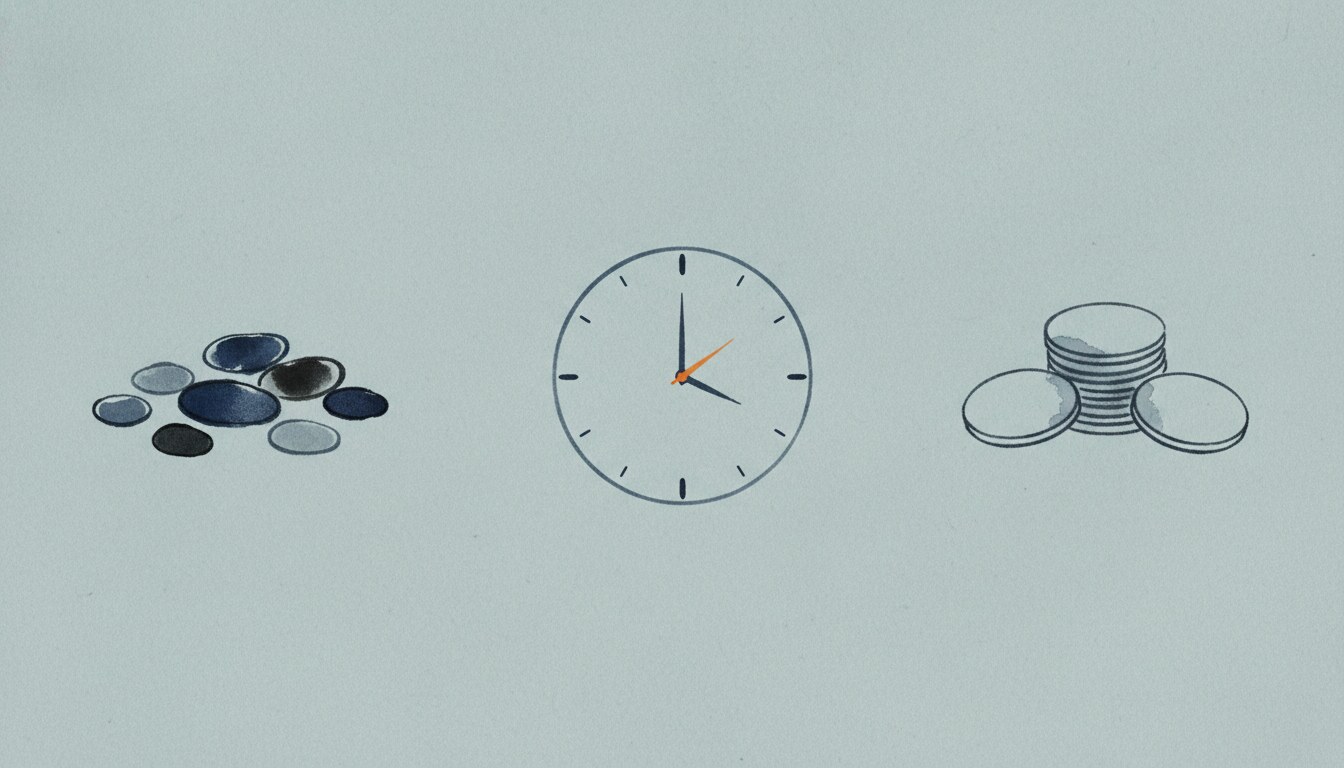
We will focus on three windows: counting, time, and money. These are the areas where dyscalculia appears earliest and most often, because all three rest on that intuitive skill we call “number sense.” We have already covered what dyscalculia is; this piece shows its face in daily life. The goal is not to spread fear, but to help you calmly name what you are seeing.
Counting: Sensing Quantity
Most children see a small group without counting one by one: if there are three cups on the table, they do not need to point at each to say “three.” For a child with dyscalculia, that instinct may not arrive on its own. Numbers stay like marks whose meaning does not settle easily.
Signs to watch for around counting:
- Skipping or muddling the order while counting (“one, two, four…”).
- Being unable to match one number to each object while counting; counting the same item twice or skipping one.
- Not being able to give the right amount when asked for “three”; saying the number but not turning it into a quantity.
- Pausing on comparisons like “which is bigger, seven or nine?”
- Still needing to count on fingers for small addition and subtraction, while peers have long memorized it.
- Doing the same problem over and over, then forgetting it the next day as if starting from zero.
What they share underneath is not speed or effort; it is that quantity does not settle intuitively in the mind.
Time: Clocks and Duration
Time is an invisible form of quantity. A clock is really a number line too, just bent into a circle. That is why dyscalculia so often shows up in struggles with time and duration.
Signs to watch for around time:
- Learning the analog clock noticeably later than peers; never quite grasping the hour-and-minute-hand relationship.
- Not sensing the difference between “five minutes” and “half an hour”; being unable to estimate how long a stretch of time is.
- Being unable to judge how long a task will take, so always running late while getting ready in the morning or planning homework.
- Muddling the order of the day, the week, the months; struggling with time relationships like “the day before yesterday.”
- Being able to read a digital clock yet not feeling what that number means as “an amount of time.”
Here too the issue is not laziness. The child struggles to find time visible and tangible, because time is an abstract quantity.
Money: Shopping and Change
Money is one of the most concrete tests of number sense. Coins and notes require combining different values into a single amount, which is a hard puzzle for a child with dyscalculia.
Signs to watch for around money:
- Mixing up the value of coins; assuming the physically larger coin is worth more.
- Being unable to judge whether the change is correct; not checking what is handed back at the shop.
- Being unable to estimate roughly what a small purchase will cost.
- Not being able to work out whether they have enough money to buy something.
- As they grow older, clear difficulty managing pocket money or keeping to a budget.
Because money ties the abstract number to the real world, it is perhaps the most visible window into dyscalculia. If your child struggles here, it is usually not from carelessness but from the difficulty of sensing quantity. To practice both of these windows gently at home, our free Clock and Money tool gives you printable clock faces and coin amounts to work through together, no pressure attached.
One Sign Is Not a Diagnosis
Every one of the signs you have read here can show up in any child from time to time. What matters is not a single moment but several signs persisting together over time. A child learning to tell time a little late says nothing on its own; but struggling across all three areas of time, counting, and money, for months, despite age-appropriate support, is a meaningful pattern.
Do not overlook age, either. A preschooler getting muddled while counting is an expected step of development. The same difficulty persisting in primary school, when peers have long moved past it, is a different story. Dyscalculia often appears alongside dyslexia; if you have noticed one, it is sensible to keep a gentle eye on the other.
Gentle Observation at Home
You do not need to treat your child as if they were being tested; in fact it is best to avoid that. A test atmosphere grows anxiety, and anxiety hides the real picture. Instead, you can observe without pressure, inside everyday life.
- Watch ordinary moments. Notice where your child gets stuck while you talk about how many plates to set, whose turn it is in a game, or prices at the shop.
- Keep small notes. A few observations like “struggles with the clock” or “never checks the change” will help a great deal later when you talk to a professional.
- Support, do not quiz. When your child gets stuck, instead of waiting for the right answer, stand beside them with a concrete tool (fingers, beans, real coins). The aim is to help, not to catch.
- Mind your words. A “let’s look at this together” tone, rather than “how can you still not do this,” protects the relationship and keeps the child from avoiding math altogether.
When to Take a Step
If the signs across counting, time, and money persist for several months despite age-appropriate support, and the child shows clear anxiety or avoidance around math, it is time to consider an assessment. A school counselor, an educational psychologist, or a specialist in learning differences is the right first stop. Catching it early means stepping in before the child settles into a belief of “I just can’t do math.”
Remember, noticing these signs is not making a diagnosis; it is simply a way of understanding your child better. Dyscalculia, like dyslexia, does not define your child; it only describes how they learn. You can find what dyscalculia is and its link to dyslexia in our first article, and to understand the child who struggles early with letters rather than numbers, see our piece on hyperlexia. For concrete tools that help at home, our guide to reading tools and apps for children with dyslexia is a good start. For more calm, research-based parent guidance, kindlexy.com is always here.