
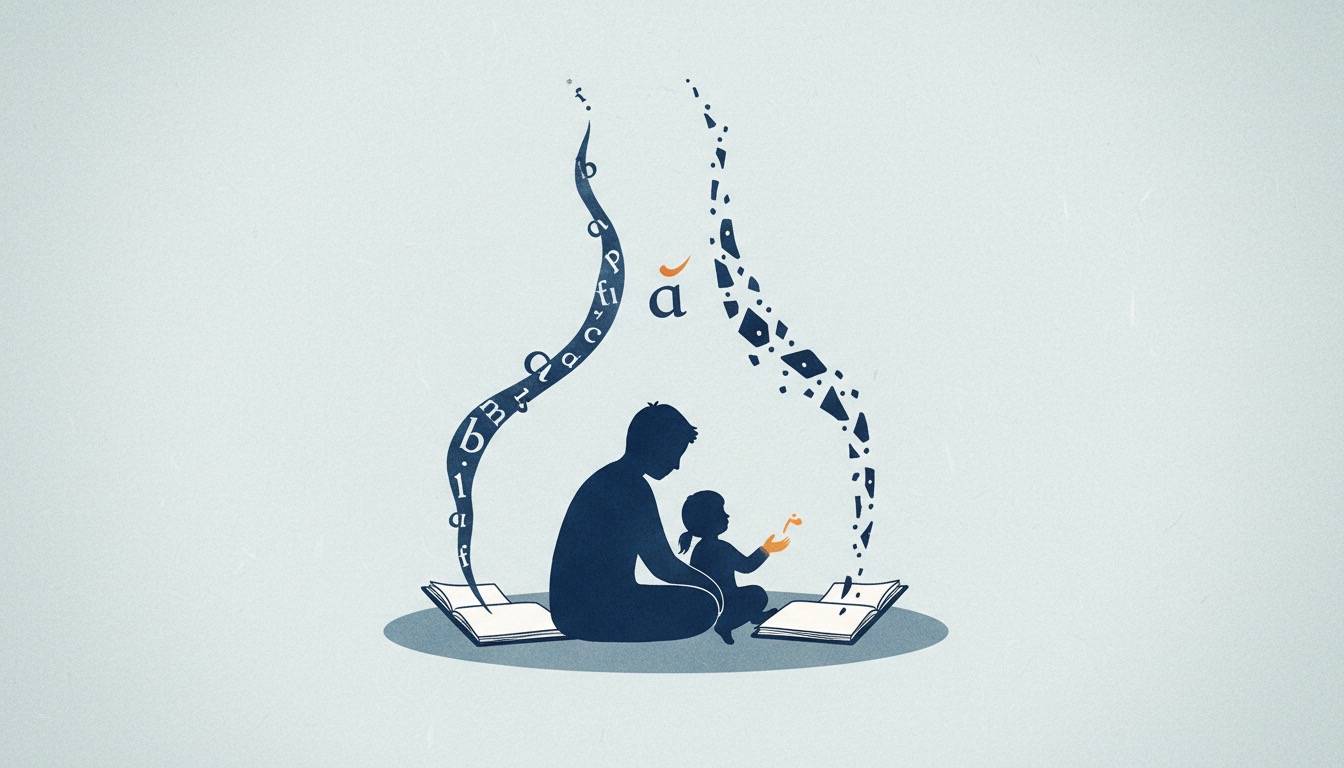
At bedtime your child reads a story in your home language as if the words pour out on their own. The same week, the school reader in English arrives and every word becomes a wall. Their eyes tire, they lose the line, they barely reach the end of the sentence.
That split picture is worth sitting with. How can the same child be so at ease in one language and so stuck in another? This article explains why that gap is exactly what the science predicts, when it can be a sign of dyslexia, and how to move forward calmly in a bilingual home.
How a Language’s Structure Shapes Reading

Languages differ in how regular the link is between how a word is written and how it sounds. Two words capture it: transparent and opaque.
- Transparent language: Letters represent sounds in almost the same way every time. A child who meets a new word can sound it out with little trouble.
- Opaque language: The same group of letters can map to very different sounds depending on context. The child has to learn the rules and the long list of exceptions next to them.
This structural difference directly affects how easy the road to reading is.
Spanish, Italian, Finnish, and Turkish sit near the transparent end. Words are mostly read the way they are written. English sits at the opaque end. The same group of letters can carry many different pronunciations.
Why does this matter so much for a child with dyslexia? Because the core of dyslexia is in telling sounds apart and bridging letters to sounds. The more irregularity a language packs into that bridge, the heavier the cognitive load. In a transparent language a child with dyslexia tires less. In an opaque language the same child wears out.
Different performance across two languages cannot be explained by the child’s interest or effort. It is the same child, the same brain, the same motivation in both. The difference is how much the language itself helps.
The Advantage of a Transparent Home Language
If your home language is transparent, it is a relatively gentle one for a reader with dyslexia. Because most words are read as they are written, the child can move forward without the rules tripping them up. The spelling stays consistent, and letters usually carry a single sound.
That advantage does not mean dyslexia is absent. It means some signs may simply be less visible in the transparent language. A child with dyslexia can still show, even there:
- Slower reading speed
- Inconsistent spelling
- Hesitation when reading aloud
- Fatigue with longer texts
These signs may just not fall far below the class average, because the transparency of the language softens them.
This Is Why Diagnosis Can Come Late
Some families notice dyslexia late. The child seems to “manage fine” in the transparent home language, then suddenly struggles when the English reader arrives. That sudden visibility does not mean something changed in the child. It means the structure of the language changed. Comparing the two languages is a valuable early signal for dyslexia.
Looking at the basic definition of dyslexia is a good way to place the bilingual picture in context.
Why English Is Especially Hard
Why is English so tiring for a child with dyslexia? A few concrete examples answer it.
“Through,” “though,” “tough,” “bough” use the same “ough” group for four different sounds. Each of these has to be memorized one by one.
“Knife,” “write,” “hour” carry silent letters, written but not pronounced. To read what is on the page you have to know that some of the letters are not really there.
Irregular verbs like “go / went,” “buy / bought,” “catch / caught” rest on memory rather than logic.
Stress is unpredictable: the noun “record” and the verb “record” share the same letters but land the stress in different places.
Accents voice a word differently, and the child tries to remember the spelling based on which version they heard.
Put all of this together and reading English becomes a doubly loaded task for a child with dyslexia. Not a sign of disinterest or laziness, but a linguistic fact.
Many families see their child’s English grades drop and reach for the verdict “not trying.” But the pattern of strong in the home language and struggling in English is exactly what you would expect in a child with dyslexia. The problem is not in the child, it is in where the language sets the bar.
What Does the Gap Between Two Languages Mean?
If your child is strong in the home language but struggles in a systematic way in English, three possibilities sit in front of you. Telling them apart takes either a specialist or time.
Possibility 1: Getting used to a new language. Every child learning a second language struggles for a while. New sounds, vocabulary, and grammar all settle at once. This phase usually starts to ease over months.
Possibility 2: Dyslexia looks different in each language. The signs in the transparent language can be quiet while the ones in English are loud. Comparing the two languages gives a richer picture than a single language assessment alone.
Possibility 3: Both at once. A child can be early in a new language and living with dyslexia at the same time. This is not rare, and an experienced specialist helps separate the two sources.
Family History Is a Clue
Dyslexia is linked to genetic predisposition. If a close family member has a history of reading difficulty, the chance of a similar pattern in your child rises. That information is a valuable note to bring with you when you see a specialist.
In Which Language Is the Assessment Done?
International guidelines say the ideal is to assess a bilingual child in both languages. Because dyslexia signs can look different depending on the structure of the language, a single language measure may miss the difficulty in the other one entirely. In practice, not every specialist is equipped to assess in two languages.
A Practical Approach
In many places assessments are mostly available in one dominant language. That is a limitation, but it can be managed with awareness.
- Talk openly with your specialist
- Describe the concrete difficulties your child has in the other language
- Share the school report and teacher feedback
- If possible, get a second opinion from a specialist experienced in the other language
This extra step is not possible for every family, and that is not a failure. Every family’s situation is different, and what matters is building the best support your child can actually reach.
A single language assessment carries a risk of missing dyslexia. The way to lower that risk is the parent’s voice. Describing the different performance across two languages in plain words sometimes catches what the test cannot.
The Particular Situation of Diaspora and Heritage Language Families
For families raising a heritage language at home while the school runs in a different dominant language, the picture shifts. The home language is spoken at the dinner table, the local language rules the classroom. For these children, “first language” and “dominant language” may not be the same thing. The school assesses the child in the local language, and the home language sometimes stays entirely outside the process.
Priorities can change for these families:
- Diagnosis is made within the system the child attends, by that country’s criteria
- Legal support comes from that system
- The home language is kept alive at home so the child does not lose a piece of their identity
Growing up bilingual does not add a dyslexia burden. A good deal of research shows that bilingualism does not make dyslexia worse, it only changes how it looks.
A Common Question: “Should We Drop the Home Language?”
“My child struggles in English, should I drop the home language too?” The answer is usually no. Keeping the home language protects the child’s family bonds and self confidence. Dyslexia support does not require sacrificing one language for another.
Kindlexy publishes in four languages (English, Turkish, German, Spanish) and takes the experience of diaspora families seriously. Our multilingual setup means the content can reach these families in their own languages too. The about page explains our curator approach in more detail.
Bilingual Support at Home
A few calm things you can do at home in the daily life of a bilingual child with dyslexia:
- Audiobooks in both languages. Audiobooks in each language feed comprehension, lighten the reading load, and keep access to the world of story open.
- Sound games for each language separately. Finding rhymes, saying the first sound, counting syllables. Sound awareness learned in one language does not transfer directly to the other, because each language has its own sounds.
- Skip the comparison. “You are so good in your home language, why are you like this in English?” can feel honest but it carries shame for the child. Talk about the two languages being different, but do not set up a race.
- Treat language mixing as natural. Switching between two languages (code switching) is a natural part of growing up bilingual, not a flaw. Watch it rather than correct it.
- Use a reading tool. Our dyslexia friendly reading tool, with adjustable font, line spacing, and background color, can be used for texts in either language.
At home it is not the discipline that matters but the warmth. For a child to build a good relationship with two languages, both languages need to live on safe and loving ground.
Where You Go From Here
Bilingualism is not an obstacle for dyslexia, only a different landscape. Your child being strong in one language and struggling in another gives you an important clue, but it is not a diagnosis. Sharing that clue with a specialist is a good way to take the right step.
Long term, calm, consistent support in both languages builds a structure that is both academically and emotionally safe for your child.
Among international sources, the Yale Center for Dyslexia page on dyslexia in other languages and the International Dyslexia Association file on multilingualism are reliable stops.
If you would like to read the stories of other families working through the same questions, kindlexy.com is here with you on the journey through its blog.