
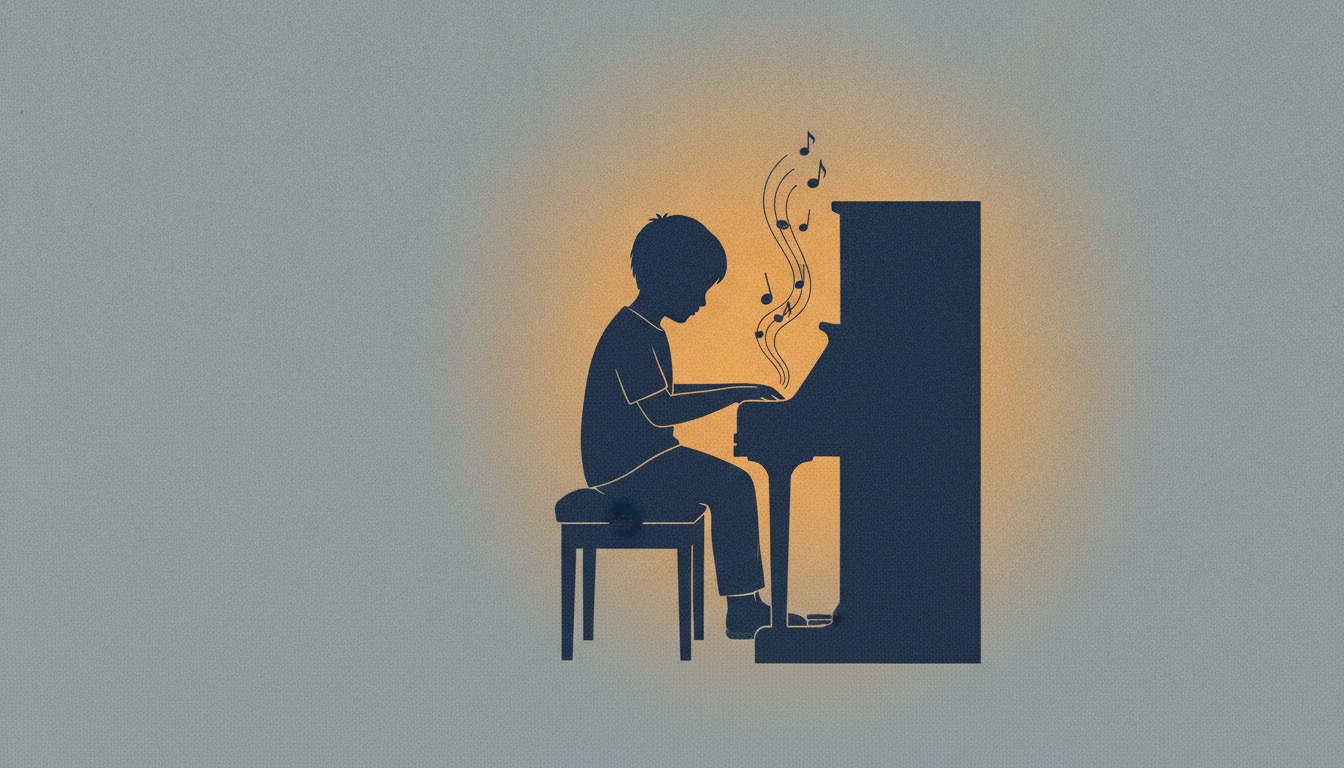
There is a scene many parents of children with dyslexia know by heart. At school, reading aloud makes their child go quiet and tight, shoulders creeping up toward the ears. Then that same child sits down at a keyboard, picks up a guitar, or taps out a beat, and something loosens. They lean in. They lose track of time. The worry that trails them through the school day sets itself down for a while.
If you have watched this happen, you are not imagining it, and you are far from the only parent to notice. The distance between “stuck on the page” and “alive at the instrument” is real, and it is worth understanding, because it tells you something true about your child.
Music and reading are closer cousins than they look
Reading and music can feel like opposite worlds, one heavy with stress, the other light with relief. Inside the brain, they are surprisingly close relatives.
Much of the difficulty in dyslexia lives in phonological processing: hearing, holding, and playing with the small sounds inside words. Rhythm leans on some of the same timing and sound systems. When a child claps a beat, keeps time with a song, or feels exactly where a note should land, they are working the brain’s sense of timing and sound structure, the very machinery that phonological awareness also runs on.
Some researchers have proposed that musical rhythm and spoken language share brain resources, and that regular music practice can, under the right conditions, sharpen the sound processing that reading depends on. It helps to be honest about where this stands. The evidence is promising, not settled, and no instrument is a treatment for dyslexia, which the International Dyslexia Association describes as a language based learning difference, not something music can undo. What we can say with more confidence is quieter but still valuable: music gives a child a place to strengthen timing, listening, and pattern through a channel that never feels like reading practice.
What an instrument can give a child with dyslexia
Set the reading question aside for a moment, because the case for music does not rest on it.
- A domain of real strength. Many children with dyslexia have a strong sense of pattern, a good memory for what they hear, and genuine creativity. Music rewards exactly those things. This fits the wider picture of the strengths that often travel alongside dyslexia, the abilities that rarely show up on a spelling test.
- An identity beyond the classroom. A child who is “the one who finds reading hard” at school can be “the one who plays” everywhere else. That second story does real work for a child’s sense of self.
- Focus that feels good. Working through a piece offers absorbed, unhurried attention. For a child who often feels behind, the experience of getting slowly, audibly better at something is steadying.
- Role models with the same wiring. A striking number of celebrated musicians are dyslexic. Seeing that can quietly rewrite what a child believes is possible for them. Our collection of stories about well known people with dyslexia includes several who found their footing in music.
The honest hurdle: reading music is its own kind of decoding
Here is the part that catches hopeful parents off guard, and it matters. Playing an instrument may come easily, while reading standard sheet music can be hard for the very same reasons print is hard. Notation is another symbol system to decode under time pressure, with its own left to right tracking, its own tiny distinctions, its own load on working memory.
So a child can be deeply musical and still stall the moment the notes land on paper. That is not a contradiction, and it is not a reason to stop. A few things genuinely help:
- Sound before symbol. Many traditions, including the Suzuki approach, teach children to play by ear first and bring in written notation much later. Learning the music in the body before meeting it on the page takes the reading pressure off the start.
- Color, size, and space. Color coded notes, enlarged notation, and generous spacing make the page less crowded and easier to track, in the same spirit as other dyslexia friendly reading supports.
- A teacher who understands. The right teacher matters more than the right method. Look for patience, a willingness to slow down, and comfort with teaching by ear. Telling a teacher plainly that your child is dyslexic, and what that means for reading notation, is not a confession. It is useful information that lets them teach well.
Naming the difficulty out loud, rather than letting your child quietly decide they are “bad at music”, protects the joy that brought them to the instrument in the first place.
Choosing an instrument and a gentle start
Parents often ask which instrument is “best” for a child with dyslexia. Honestly, there is no single answer, and any list that promises one is overselling. The better question is which instrument fits this particular child, right now.
- Follow the pull. The instrument your child is drawn to, the one they keep gravitating toward, already has motivation built in. That matters more than any theoretical fit.
- Rhythm forward starts are friendly. Drums, percussion, and piano give immediate, physical, satisfying feedback, and they lean on rhythm and touch before they lean on reading.
- Mind the reading load at first. Instruments and teachers that begin by ear let a child build real skill and confidence before notation enters the picture.
- Readiness beats age. There is no perfect window that closes forever. A slightly later start with genuine interest usually beats an early start pushed from the outside.
What not to do: do not build another arena to fail in
This is the one thing worth guarding above all else. The reason music helps is precisely that it is not school. The moment an instrument becomes another place to be measured, corrected, and found wanting, it can lose exactly what made it good for your child.
So keep an eye out for a few traps:
- Do not turn practice into a second homework battle. Short, warm, regular sessions beat long ones that end in tears. Ten willing minutes are worth more than forty resented ones.
- Go easy on performance pressure. Recitals, grades, and exams are optional, not the point. Plenty of children flourish for years without ever sitting a formal music exam.
- Do not let reading notation become the gate to playing at all. If a child has to master the page before they are allowed to enjoy the sound, many will simply walk away.
- Keep your own disappointment off the bench. Your calm is part of the method here, just as it is with reading.
How you talk about all of this matters as much as what you do. If you are unsure how to name a difficulty without denting your child’s confidence, our guide on talking with your child about dyslexia offers language that keeps the door open.
The takeaway
If your child is tense on the page and free at the instrument, trust that contrast. It is telling you something real about where their strengths live and where the pressure is coming from. Music is not a cure for dyslexia, and it does not need to be. It can be a place of rhythm, mastery, and pride, and those are worth protecting entirely for their own sake.
Keep the instrument close to joy and far from the report card. Follow what pulls your child in, keep the early reading load light, and let them be, for a while each day, simply a musician. If you are looking for more calm, practical ways to support a child with dyslexia at home, the Kindlexy tools are a good place to look next.